At a time when amateur music practice is evolving profoundly, the French Musical Confederation plays a major role. Its history is impressive, and its daily presence provides support and recognition to many collective or individual journeys. Whether the mission is to secure association management, organize training, or imagine new encounters, the CMF distinguishes itself above all by the strength of its human network and the plurality of its resources. Supporting each actor in the musical world requires constant attention – many volunteers and professionals thus benefit from rigorous and warm support, while a constructive debate opens on the central place of music in our territories (several trainers regularly testify to a real local dynamic).
French Musical Confederation: Missions, Organization and Essential Resources
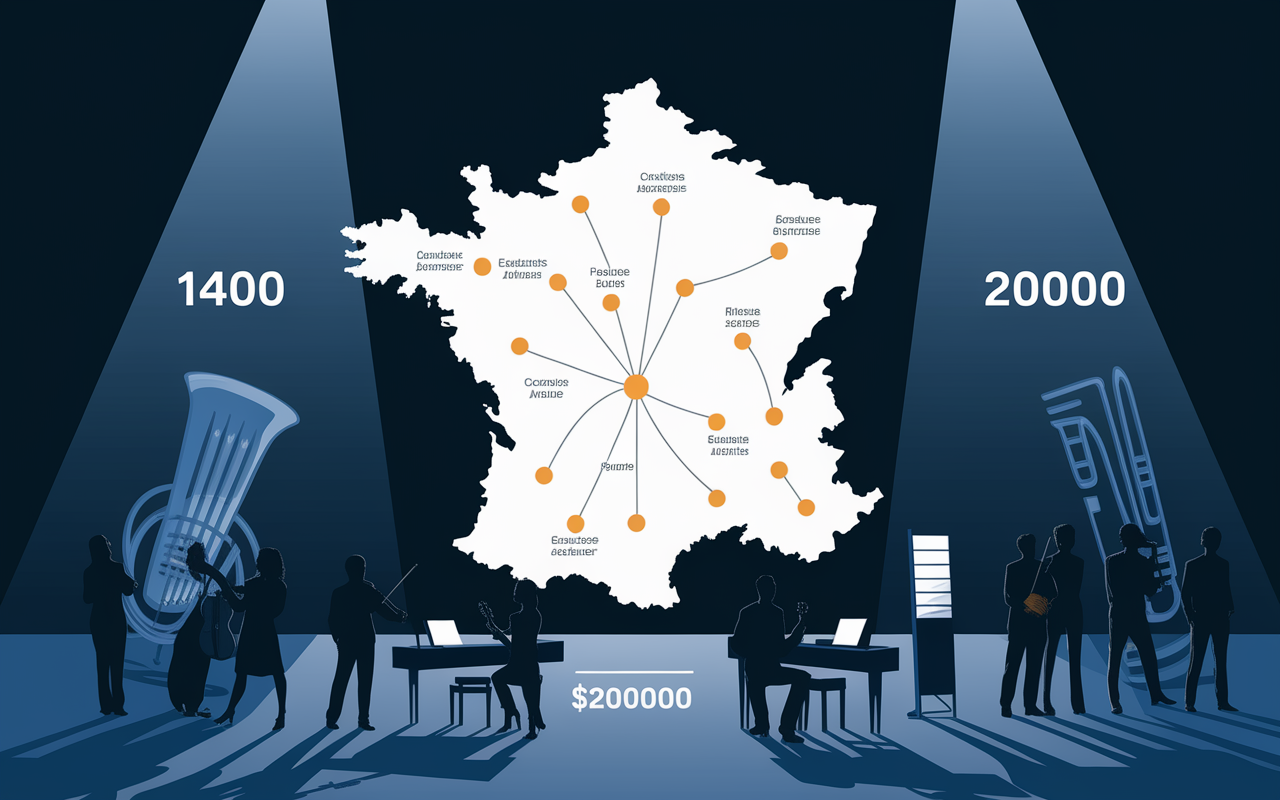
Are you looking for a trusted partner to federate, support, and highlight amateur music practice in France? For more than 160 years, the French Musical Confederation (CMF) has fulfilled this function by bringing together between 200,000 and 300,000 members, 1,400 music schools and 3,800 ensembles throughout the territory. Recognized as a public utility organization and partner of the Ministry of Culture, it offers a complete set of services for musicians, associations, and schools wishing to enliven collective musical life.
From the first contact, it’s regularly observed that the CMF is more than an institutional foundation: it offers concrete possible options (association management, training, collective agreements and insurance, event organization, document and music catalogs, pathway support, etc.). Any group involved in amateur music thus benefits from real levers, guides, and opportunities to get involved, with a territorial network recognized as unique in France. The testimony of a rural association president regularly highlights the ease of access to resources, even for those furthest from major centers.
The history of the CMF testifies to its ability to reinvent itself and transmit. From the early days under the Second Empire to the post-pandemic transformation period, this journey echoes the strength of the French musical collective, always in motion.
Looking Back at 160 Years of Musical Federalism
Founded in 1860 to bring together French civilian musical societies, the CMF went through two world wars (with a temporary interruption), before obtaining public utility status in 1957. Across all regions, more than 112 federations maintain this living network today that values collective musical practice, from big cities to the most rural corners: the sustainability of the 1,400 schools and 3,800 affiliated ensembles attests to this. A teacher recently shared her students’ amazement at the variety of ensembles available “just near their home.”
The speed of evolution remains striking: how does an organization born in the 19th century reactivate after the pandemic or implement digital catalogs covering more than three decades of archives? The CMF doesn’t hesitate to experiment with new tools to remain relatively current, according to its members’ experiences.
Institutional Recognition and National Reach
Thanks to its public recognition, the CMF assumes a central role in dialogue with the State: regular exchanges with the Ministry of Culture, agreements with SACEM, defense of musicians’ rights, educational and social support, etc. Significant anniversaries, such as the 140th anniversary of the Ennezat Harmony Orchestra or the 145th anniversary of the Gonneville-la-Mallet Harmony, illustrate the strong link between the CMF and local association territories.
One last point to note – the administrative headquarters is located at 10-12 Avenue de la Marne, 92120 Montrouge, while the Rhone-Grand-Lyon branch is located on Rue Vendome in Lyon. This organization facilitates direct contacts, adapted to everyone’s needs. A federation official recently mentioned the interest of these relays for resolving logistical issues in a few days.
Federal Services and Programs
Behind the institutional dimension, there’s a “toolbox” designed to help music associations at every stage, whether it’s training, management, insurance, or documentation research. Several of these programs are pooled for the direct benefit of members.
Insurance and Collective Agreements – Security and Compliance
A system of pooled insurance protects both ensembles and schools: claim declaration via forms or online simulation, support on collective agreements (SACEM, SACD, SEAM, SPEDIDAM) to guarantee a legal and social framework adapted to the association music world. This program removes many obstacles, from the brass band president who must manage an urgent situation to the HR manager of a music school who anticipates changes in social law.
It’s noted that each year, more than 350,000 musicians benefit from these tools: administrative guides, scales, and simulators are updated at each association start of year. It sometimes happens that a structure discovers through a webinar that it could benefit from broader coverage than expected.
Training, Resources and Educational Support
Continuing education remains a central dimension of the CMF network. Topics covered range from orchestra conducting to HR management, including disability support, prevention of musculoskeletal disorders, or use of digital tools. Members regularly benefit from webinars, workshops, and certifications like the DADSM or CRDSM pathways, accessible in several disciplines.
Another point: any member can find an annually updated documentary catalog, including archives, competition programs, scores, guides, audio catalogs by instrument (more than 30 years of archives). This program effectively facilitates sometimes fragmented and lengthy research – a training coordinator recently mentioned the time savings offered by documentary pooling.
Events and Association Life
The CMF is also a diversity of events that highlight live music. Throughout the year, association life is enriched by meetings, collective emulation, and recognition of achievements.
National Competitions, Championships and Workshops
The federal calendar revolves around iconic competitions: National Brass Band Championship (21st edition in 2026), 2nd National Harmony Orchestra Championship, regional festivals, thematic workshops (brass, juniors, traditional music). Application deadlines can be specific: typically, requests must be submitted before December 10, 2025 for commissions, or October 15 for Franco-German aid.
But beyond competition, these events take on strong significance in terms of training, sharing, and discovery. Some volunteers tell of the joy of seeing young musicians – supported by a European Youth Brass Band – rub shoulders with members celebrating the 140th anniversary of their local orchestra. Is it really just a matter of performance? One can assume that the intergenerational aspect plays a major role in the sense of federation.
Association Life, Press Review, Meetings
One of the daily faces of the CMF is also dialogue: exchange mornings, general assemblies (example: the RGL met on March 28, 2026 at 9 AM), webinars, press reviews or newsletters to maintain musical awareness, draw inspiration from external projects, or obtain concrete help when needed. A trainer recently mentioned the reassurance provided by the newsletter in times of doubt.
Keep in mind: the Rhone CMF offers office hours, open particularly on Mondays, Tuesdays, and Thursdays from 9 AM to 5:30 PM. This service highlights the real availability of a human-scale network, where you can reach someone for practical advice or an association emergency.
How to Join and Get Involved
Membership in the CMF unlocks most of its services, adapted to the size and aspirations of each team (school, harmony, orchestra, choir, etc.). Getting involved means joining a dynamic and fully participating in the vitality of the local and national musical network. A rural school director recently shared the enrichment of having joined the federation.
Procedure, Conditions and Support
Registration is mainly done online: dedicated form, choice of structure type, payment of membership fee (according to staff), activation of the member area allowing access to guides, directory, and agreements. The federal team supports all new structures, refining needs or building the file for a specific aid or training request.
For practical questions (finding your local federation, simulating a membership fee, registering for a competition), the member area and regional pages of the main site serve as a one-stop shop – an organization deemed remarkable by many association actors: “we don’t waste time, everything is online,” notes an orchestra director.
Offers, Calls for Projects and Opportunities
Calls for projects are highlighted by the CMF: composer residencies, employment support, creation grants, participation in major events like the European Youth Brass Band (with the 22nd session announced). Files are generally accessible online and preparation benefits from guides to avoid any oversight of detail.
Let’s add that many programs are also open to member groups from rural territories. A trainer specified during a webinar that “territorial equity is part of the network’s DNA.” This is also why mobilization remains strong, regardless of the geographical context.
Testimonials and Distinctions
Over the years, the CMF has built a rich culture of recognition: anniversaries, distinction ceremonies, spotlights on dedicated volunteers. These awards are worth much more than simple honor: they reveal a resilient and inventive association life, capable of overcoming collective challenges (a musician was recently distinguished “for 30 years of local volunteering”).
Lived Stories and Recognition of Association Journeys
Who has never experienced the satisfaction of seeing their orchestra cited in a magazine or distinguished with a medal? CMF news offers many illustrations: the Ennezat Harmony celebrated its 140th birthday, Gonneville-la-Mallet its 145 years. Other stories highlight junior conductors or volunteers building innovative projects – most often far from national media. It’s noted that these trajectories powerfully nurture the sense of belonging to an association “family,” visibly distinct from solitary practice.
Access to distinctions is through transparent and accessible formats, sometimes linked to calls for applications or annual regional elections.
CMF FAQ
Here are the most frequently asked questions, a useful resource for any first contact or quick search.
Frequently Asked Questions: Your Essential Landmarks
- What is the CMF, and who can join? Any amateur music group, association, or collective can request membership online or through a local federation; some school ensembles recently benefited from this support.
- What services does the CMF offer? Among the key points, there’s pooled insurance, collective agreements, various HR guides, training, administrative support, events, newsletter, or the vast documentary catalog. These programs represent a concrete lever for between 350,000 and 400,000 musicians each year.
- Where to find a CMF departmental federation? The main site offers a complete directory in the “Find my federation” section, facilitating quick location and direct contact with local relays.
- How to participate in a national competition or event? Registration files are posted online well in advance: some competitions require, for example, a deadline of December 10, 2025 for the largest events.
- What financial support is provided? FDVA grants, employment aid, brass band plans, creation grants, or logistical support are obtained from the relevant federation or in online documentation (a rural orchestra conductor confided having obtained a grant after a simple phone call).
- Are there tools accessible online? You can access membership fee simulators, claim forms, the documentation center, the recording catalog, as well as guides and test scales updated each season.
- What about collective agreements? The CMF offers complete and adapted support for local application, in close connection with institutional and legal partners.
For any additional information, browse the resources at: CMF official website, an excellent starting point, whether you’re curious, a parent, volunteer, or passionate about amateur music.