Overlooking the gorges of Haute-Loire, the Lignon Viaduct is not just an engineering feat on the RN88, but stands as a silent connection point between local memory, safety concerns, and regional life. Moreover, when you listen to the stories of local residents and professionals, you better understand how this structure embodies both technical prowess and social value, far more than its impressive figures suggest.
Lignon Viaduct: key facts, role, and location on the RN88
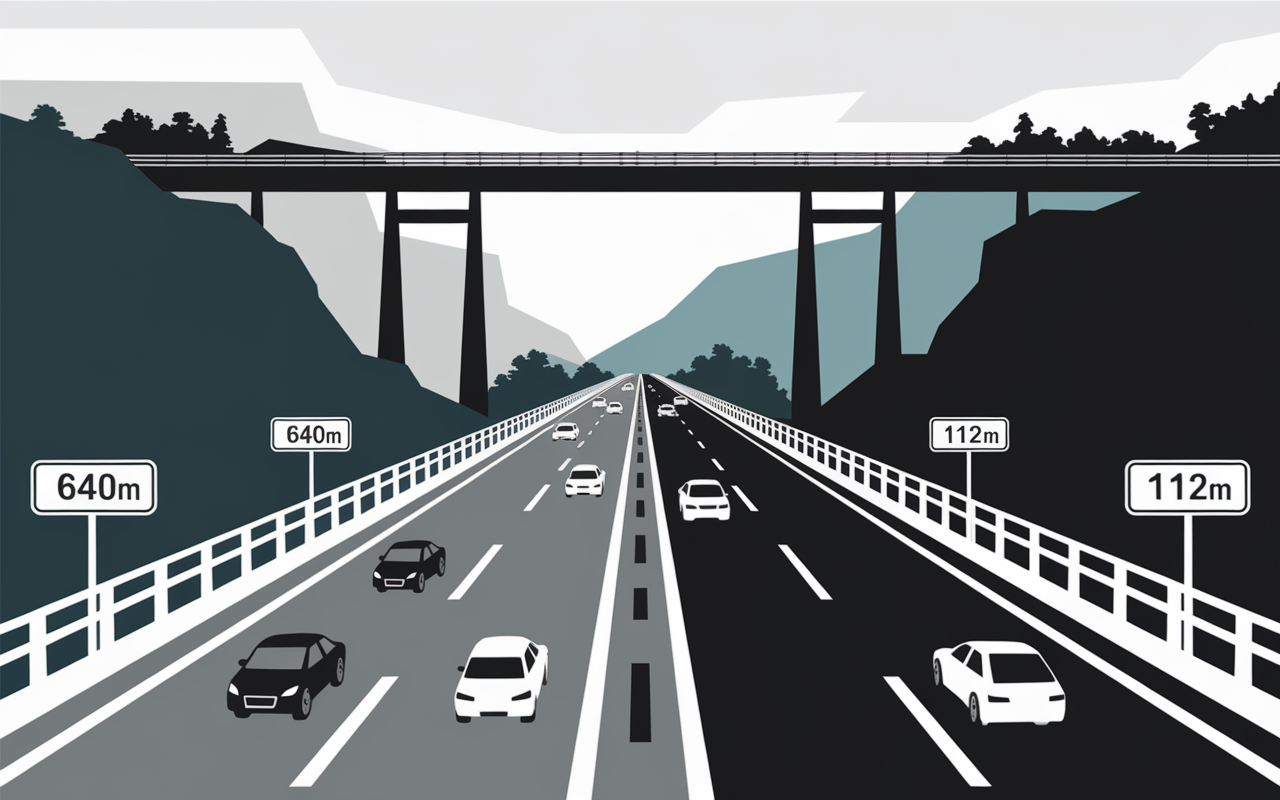
Both a technical feat and a viable solution to a major safety problem, the Lignon Viaduct has stood since 1993 as an iconic landmark of the Haute-Loire landscape and a central piece of the RN88. First and foremost, it’s worth recalling the fundamentals:
Located between Monistrol-sur-Loire and Saint-Maurice-de-Lignon, the viaduct spans the Lignon gorges in the heart of Haute-Loire, on the frequently traveled route between Le Puy-en-Velay and Saint-Etienne. Its construction made possible the bypass of the old route, known for being dangerous, which wound through the gorges and the village, ensuring the safety of the 8,000 to 10,000 daily vehicles in this area.
With its 640 meters in length and up to 112 meters in height, it remains, thirty years later, one of the giants of civil engineering in France. Its steel and concrete deck was pushed at a rate of 20 meters per hour – a relatively rare method at the time. The site is not accessible on foot except for certain supervised events, but it can be admired from rest areas or viewpoints or during a family trip (a local guide recently mentioned the interest in discovering it in different seasons).
Regarding the data: 1,900 tons of steel framework, 12,300 cubic meters of concrete, 133 million francs invested. Perhaps you’ve already passed it without suspecting its history… Now it’s a bit clearer.
Precise location and road access
The Lignon Viaduct dominates the gorges at the exit of Monistrol-sur-Loire, in Haute-Loire, connecting the two banks on the RN88. It serves as a junction between Saint-Maurice-de-Lignon and Monistrol. It is located approximately 35 minutes from Le Puy-en-Velay, as well as 45 minutes from Saint-Etienne. For travelers, it constitutes an obligatory passage between the valley and the plateau.
Some useful reference points:
- RN88 – Main route connecting Le Puy-en-Velay and Saint-Etienne, quick and safe access option
- Viewpoint on the Monistrol side: accessible with parking, educational signs, ideal for discovery stops
- No pedestrian walkway on the deck, only vehicle crossing to preserve safety
- Free traffic: the viaduct remains open except for rare annual maintenance operations
A detail reported by some: during anniversaries, pedestrians are sometimes exceptionally allowed to walk across the bridge, supervised by teams. We always imagine permanent access, but the dream has not yet been fulfilled.
Timeline and construction history
Behind the peaceful appearance of the structure lies a milestone-marked adventure – supported by technical challenges and bold choices. The Lignon Viaduct construction site remains engraved in local memory, mobilizing elected officials, workers, and expertise against demanding nature.
Work began in 1991, with the constraint of granitic terrain and dizzying depths. The deck, a steel-concrete composite, was “pushed” from the south bank at a rate of 20 meters per hour, a performance still praised by professionals. The final connection, on January 8, 1993, was marked by a small celebration suspended in the air, reported as a fair “clinging to the void” in local newspapers.
Project management was shared between the State (CETE Lyon), the Auvergne-Rhone-Alpes Region, and the Haute-Loire Department, while the company Demathieu Bard deployed its seasoned teams, recognized for this type of bridge.
A rare fact to note: the schedule was met with notable precision for the time. Road commissioning took place on November 19, 1993 – the official inauguration, under the leadership of Edouard Balladur, on February 25, 1994. In just three years, the titanic structure came to life before hundreds of spectators, which still fuels local memories.
Testimonies and construction site anecdotes
Local workers remember “the winter of 1992, freezing and dizzying,” when installing climbing formwork put teams to the test. It was not uncommon to hear the chief engineer state that “the real challenge is the wind more than the concrete…” These stories reveal the human dimension behind the technology and nurture the regional attachment to this giant.
Some residents recall that during the final deck connection, “the bridge vibrated under our feet, we really thought it would come alive.” This type of anecdote, passed down through generations, gives the construction site a life of its own – a testimony shared in Haute-Loire schools in recent years.
Technical characteristics of the viaduct
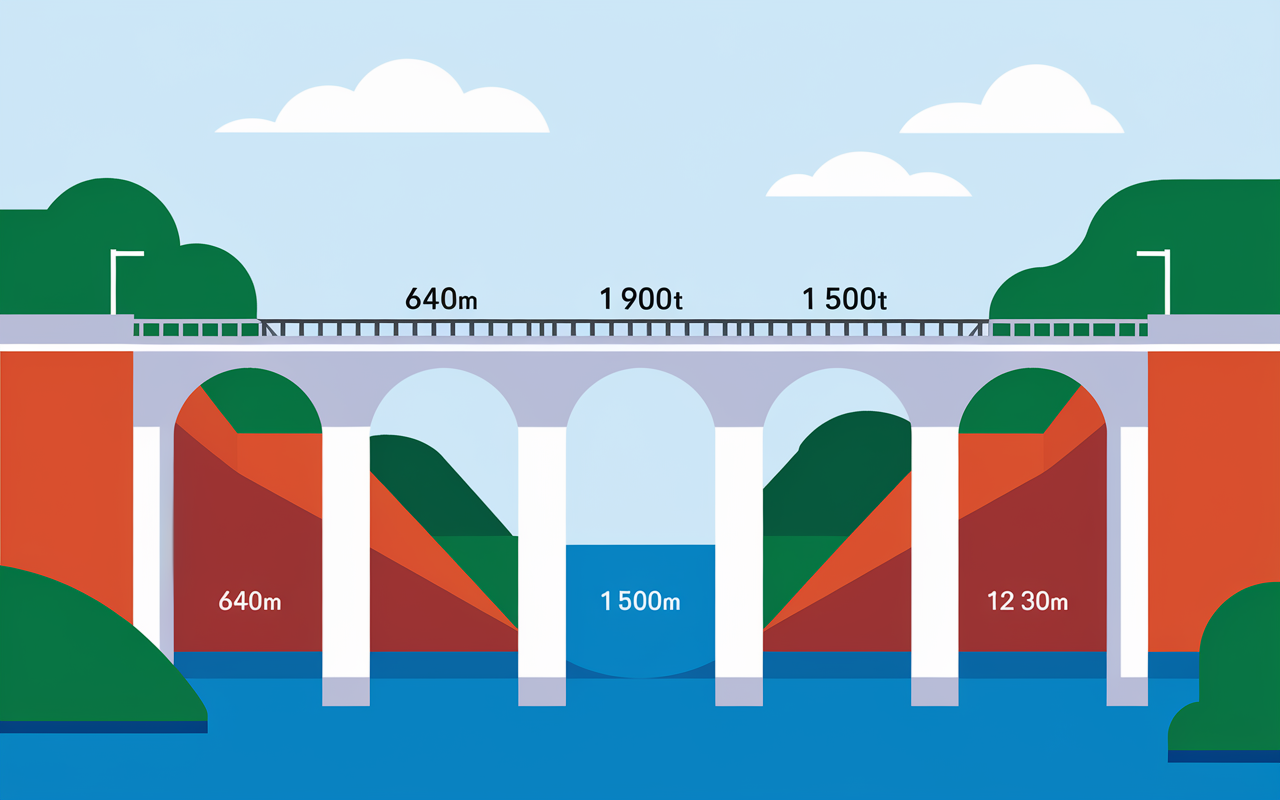
On the civil engineering scale, the Lignon Viaduct remains remarkable for its proportions and the techniques employed, regularly studied by students and engineers alike.
We note 640 meters long, divided into 7 spans – five of which are 100 meters each, a record at its opening. The piers reach 112 meters above the Lignon riverbed, which impresses with each new visit. Following up on the figures mentioned above: 12,300 cubic meters of concrete injected, almost half in the foundations. The steel framework weighs 1,900 tons, with 1,500 tons of steel dedicated to reinforced concrete. This famous “pushed deck” rests on piers planted in granite: engineering in its purest form.
Looking further: Millau, today’s record holder for the highest French viaduct, was only inaugurated a decade after Lignon. At the time, residents of the area rejoiced at this national title, and more than one trainer still explains this passage in their courses.
| Characteristic | Key figure |
|---|---|
| Maximum height | 112 m |
| Total length | 640 m |
| Steel framework | 1,900 t |
| Reinforced concrete | 1,500 t |
| Concrete volume | 12,300 m3 |
| Road asphalt | 800 t |
Funding and institutional stakeholders
The cost of the project reached 133 million francs (approximately 20.25 million euros). It’s the balanced distribution that draws attention: 50% funding from the State, between 30 and 35% from the Region, 18% from the Department. Each bet on this project to open up Haute-Loire and enhance the territory’s image.
Unsurprisingly, the rigorous division of costs frequently appears in regional media, a sign of the deep transparency and institutional dialogue that marked the negotiations. Several current elected officials continue to cite the viaduct as an example when it comes to major public projects.
Impact on safety and local life
If the Lignon Viaduct has become so significant in collective memory, it’s primarily for its role as a safe bypass. Going from a winding road, prone to accidents and traffic jams, to a spectacular aerial route: the transformation of local daily life is profound.
Previously, the RN88 route forced motorists and road professionals to endure numerous slowdowns, mixed with risky curves and regularly difficult weather conditions. “Every winter, we feared pile-ups,” reports a driver from Saint-Maurice, while a local transporter recalls nights spent stuck in the gorges.
Since commissioning, thousands of trips have been facilitated, the number of accidents has dropped sharply, and traffic has generally become smoother, even if some residents regret a certain desertification of small villages. But it must be acknowledged that safety has taken precedence over nostalgia, according to several Department officials.
Concrete benefits for motorists and local residents
Let’s note some facts that locals often highlight:
- Before: numerous accidents, extended travel times, generalized tension during weather episodes
- After: direct routes, precious time savings, serious accidents now exceptional
- Traffic was able to reach 10,000 vehicles/day in the 2000s, a density absorbed without negative effect on safety
- “Measured ecological effect”: the choice of suspended deck allows fauna and vegetation at the bottom of the gorge to survive without massive concreting
It’s precisely this alliance between technical achievement and daily life improvement that makes the viaduct valued locally.
Heritage memory and anniversaries
Thirty years after commissioning, the Lignon Viaduct continues to generate pride in surrounding villages. Anniversary celebrations bring together elected officials, former construction workers, and families to maintain a living common heritage. Ultimately, a bridge always embodies a collective story, not just a structural feat.
Each anniversary or maintenance operation puts the viaduct back in the spotlight, and the press frequently uses it as a reference in civil engineering training. It’s sometimes compared, in local discussions, to the “little brother of Millau.” In other words, it’s a living memory, revived by student visits and information panels found at viewpoints.
Sometimes hikers ask: “Can we imagine crossing on foot someday?” For now, no opening is planned, but this desire for direct connection proves how much this viaduct is an integral part of the region.
Reports, galleries, practical resources
To extend your visit or delve into the history, various resources are available: anniversary reports in local press like Le Progres, photographic archives of the construction site, and detailed diagrams accessible online. Many readers say they appreciate the “The viaduct in numbers” series, which serve as a bridge between old memory and current uses.
One last point to note: it’s possible to report errors or look for new files. Sometimes, at the Monistrol viewpoints, you’ll find enthusiasts comparing Lignon to other giants – some leave amazed by the local scale of the project.
Technical and fun FAQ – Lignon Viaduct
Do you still have questions about the viaduct? Here are some answers for all curious minds, in all simplicity.
When and how was it built?
Between 1991 and 1993, with the final connection on January 8, 1993. Method used: pushing of the steel-concrete deck, foundations with climbing formwork for the piers.
Dimensions and maximum height?
640 meters long, 112 meters high, 7 spans including five of 100 meters – the French record at its opening.
Why this viaduct?
To bypass the gorges deemed dangerous, secure the RN88, and open up the regional plateau.
Can you visit on foot?
No, except for certain official occasions: access to the viewpoint is recommended to enjoy the panorama.
What was the cost and who funded it?
133 million francs (approximately 20.25 million euros); coverage: State 50%, Region 32%, Department 18%.
Visual gallery and additional resources
To get a precise idea, nothing replaces immersion in archive photographs and technical diagrams available online. There you’ll discover striking images of the construction site, the famous deck connection in the middle of the cold winter, or the 1994 inauguration. All these resources remain accessible via regional and technical portals (Structurae, Wikipedia).
For those who wish to go deeper, Le Progres archives provide access to numerous files, while Structurae reveals many construction secrets. Haute-Loire has not finished transmitting the memory of its Lignon Viaduct…