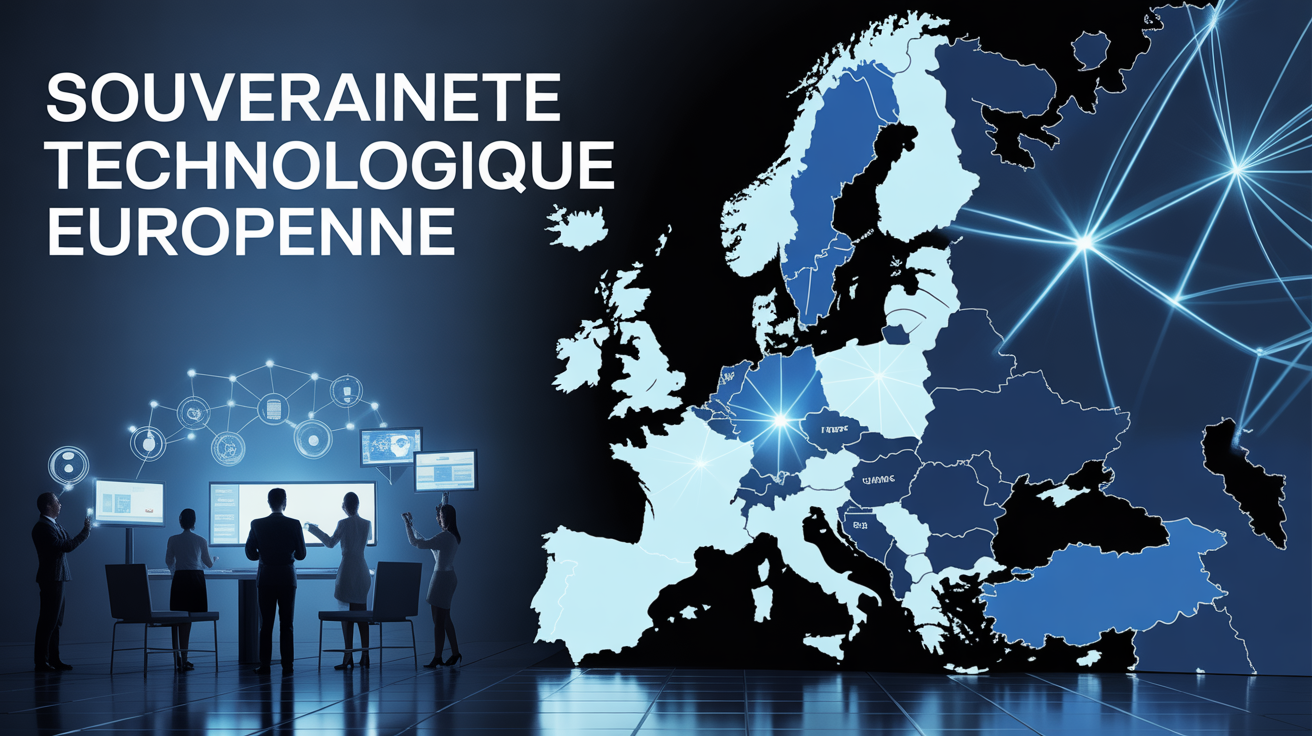
At a time when Europe seeks to strengthen its technological sovereignty, Andre Loesekrug-Pietri finds himself at the center of a movement that relies on collective action, bringing together talents and energies around the Joint European Disruptive Initiative (JEDI). This approach aims to transform the continent’s challenges into concrete benefits; his international background, tinged with intellectual curiosity and pragmatism, illustrates an ambition shared by many stakeholders. One might say there is a genuine desire in him to encourage a pluralistic European innovation, driven by those who value diversity of perspectives in the digital transition.
Andre Loesekrug-Pietri: European architect of disruptive innovation

Recognized as one of the drivers of European technological renewal, Andre Loesekrug-Pietri embodies a Europe tackling the conquest of digital and scientific sovereignty through disruptive innovation. Now president and chief scientific officer of JEDI, he has been guiding continental strategy since 2018 by promoting “moonshot programs” designed to rival major international agencies, like the American DARPA.
With over 14,000 followers on LinkedIn and regular columns on Europe1, Loesekrug-Pietri plays the role of facilitator and accelerator for the European transition. Behind this institutional image, one might wonder: who is this leader? Where does he really come from, and how did he establish himself in the demanding world of disruptive innovation? A trainer recently explained that his ability to navigate between distinct worlds surprises more than one observer – proof that cross-functionality sometimes has its unexpected champions.
A multisectoral and international career
Of Franco-German origin, Andre Loesekrug-Pietri first distinguished himself through the richness of his career: a graduate of HEC, having attended Harvard Kennedy School, he has a total of 15 years of experience in private equity, including 10 years spent in Asia. After this stage, he took on industrial responsibilities at Airbus. In 2017, he held the position of special advisor to the Ministry of the Armed Forces, a dive into the heart of defense issues, which allowed him to refine his thinking around Europe’s own technological sovereignty.
This journey, combining private sector and public commitments, gives him rare credibility among decision-makers, investors, industrialists, and research institutes. Some professionals regularly mention his ability to “effortlessly bring together” the financial, industrial, and political worlds – a talent not so common in the European ecosystem. It’s not unusual for an investor to cite this profile as a model of openness and eclecticism.
International recognition and distinctions
Among the recognitions, Loesekrug-Pietri was selected as a Young Global Leader by the World Economic Forum and sits on the Innovation Board of the Munich Security Conference. All roles that allow him to extend a network of international experts ready to support an ambitious and independent vision for Europe. His activities remain dynamic, between conferences, LinkedIn publications, and intervention videos that mark debates on technological sovereignty.
- Over 500 active LinkedIn connections, a dense network that frequently impresses and measures his mobilization capacity.
- His Franco-German dual nationality symbolizes a Europe turned toward openness and cooperation (several collaborators emphasize the richness this cross-functionality brings to projects).
But a question often comes up: will the ability to unite be enough to initiate truly concrete transformations in European deeptech? This is one of the most discussed questions at recent forums – and opinions remain divided.
JEDI: catalyst for European breakthrough initiatives

In Europe, the fragmentation of innovation ecosystems represents a well-known problem. JEDI, created in 2018 and chaired by Loesekrug-Pietri for over five years, aims to meet the challenge head-on. “Our ambition is to imagine a disruptive innovation agency as effective against challenges as DARPA – but adapted to our European context,” he explained during a presentation at Sciences Po Paris.
Organization and strategic missions of JEDI
The Joint European Disruptive Initiative’s mission is to identify, support, and accelerate so-called “disruptive” innovations: one immediately thinks of the famous Moonshot programs. This collective relies on the mobilization of over 7,000 scientific and industrial experts from 30 member countries, building on a flexible and cooperative model. JEDI marked a turning point by launching its first European GrandChallenge in 2020, an event that marks the long-awaited beginning of a deep innovation dynamic on the continent.
It’s worth noting that Europe took time before organizing a challenge of this magnitude – some experts even consider that the wait until 2020 illustrates both the gap to close and the hope generated by the JEDI method.
- First GrandChallenge initiative launched in 2020, a key milestone for sector observers.
- Over 5 years of presidency and constant leadership by Loesekrug-Pietri (a commitment closely followed in the deeptech community).
Impact areas, governance, and operating mode
JEDI operates on several major fronts: health, environment, digital technologies, education, oceans, and space. Governance, based on agility and collaboration between public and private sectors, explicitly aims to break down the institutional silos often criticized in Europe, and to carry projects with high societal impact.
Some open innovation experts highlight the multiplicity of collaborations and proximity to field actors. Concretely, JEDI’s operation relies on several levers:
- Strengthened relationship with universities, laboratories, deeptech entrepreneurs, and European industrialists (which occasionally allows little-known innovators to secure support).
- Calls for solutions open to any project holder on the continent, following a transparent and inclusive process.
- Facilitation of access to expertise, funding, and institutional support through strategic partnerships.
The collective emphasizes responsiveness and assumed risk-taking: “No more comfort of the status quo, it’s really better to stimulate boldness,” summarized a board member in a recent interview. This philosophy particularly appeals to young entrepreneurs; some have testified to joining JEDI for this reason.
Moonshot programs and technological sovereignty
While Europe questions the management of its technological dependencies, Moonshot programs constitute JEDI’s relatively innovative signature. But what do these initiatives really look like, and why does the model generate both a lot of interest and sometimes a dose of institutional skepticism? A public policy researcher recently mentioned this tension as a driver of collective creativity.
Challenges inspired by DARPA, adapted to Europe
Moonshot programs bring together ambitious, risky projects with high potential impact in key areas such as artificial intelligence, quantum computing, biotechnology, energy, or cybersecurity. JEDI launches these Grand Challenges openly, encouraging constructive competition among all participating countries to stimulate excellence.
In practice, the very first European GrandChallenge started in 2020. It was accompanied by a stated desire to match, or even surpass, American and Chinese agencies on certain axes. One might wonder how far Europe could go – where others are already powerful and well established.
European positioning, differentiation, and hopes
Unlike DARPA, which operates solely on public funds, JEDI offers a multi-stakeholder model: the direct involvement of startups, companies, and laboratories gives the project an original scope. This logic of “coopetition” (cooperating while remaining competitive) is, according to several analysts, a promising viable option for anchoring European technological sovereignty in a lasting way.
- 6 major priority themes broadly cover the main sectors of the European transition (health, energy, cybersecurity, etc.).
- The desire to involve industrialists, researchers, and institutions from the start to ensure the relevance and solidarity of actions (a European governance expert emphasized the robustness of the network).
Some results are expected in the medium term – sometimes within 2 or 3 years – for the most strategic Grand Challenges, according to several announcements made at recent conferences. Let’s admit it, Europe is eagerly awaiting tangible signs of effectiveness, and the final impact of this approach will certainly be part of future institutional assessments.
Expertise, interventions, and media reach
Outside the institutional framework, Loesekrug-Pietri stands out through substantial editorial activity: radio columns, podcast appearances, conferences at major schools. Some JEDI members recently estimated that his voluntarism outside the chambers is surprising, and that his ability to popularize challenges both students and business leaders alike.
Popularizer and transmitter of technological transitions
Almost every week, he speaks to deepen the issues of sovereignty, innovation, and technological geopolitics. A columnist on Europe1, educator at Sciences Po, regular guest at international forums: he manages to make sometimes very complex topics accessible, which earns him the esteem of varied audiences.
His impact is observed to touch very different spheres:
- Europe1 columns focused on news in European innovation.
- Active participation in Economic Meetings, Responsible Economy Forum, and various podcasts or conferences; one speaker noted his ability to spark exchanges.
- LinkedIn articles followed by over 14,000 people, gradually weaving a community engaged around European sovereignty.
He readily and straightforwardly answers questions from the public or shares his doubts on certain subjects, a positioning that really contrasts with the traditionally very standardized institutional discourse.
Production, collaboration, and influence
Around Loesekrug-Pietri, academic and institutional partners – behind the Munich Security Conference or the FrenchTech Beijing incubator, notably – recognize his role as a bridge between sometimes distant worlds. This cross-functionality constitutes both a strength and a real daily challenge: maintaining a coherent vision while ensuring growing impact. It’s not uncommon for multidisciplinary teams to rely on his method to avoid insular thinking.
Contact points, networks, and newsletter
Do you want to delve deeper into the subject, join the network of influence, or simply follow the news of Andre Loesekrug-Pietri and JEDI? Here are the channels to know to stay informed about his upcoming appearances or open calls for projects. In the digital age, it becomes really easier to connect to these innovation levers.
Resources and actions at your fingertips
To follow his activity, several options are available:
- Access his LinkedIn profile – over 14,000 followers – : Andre Loesekrug-Pietri on LinkedIn
- Discover the official JEDI page: jedi.foundation
- Subscribe to the JEDI newsletter and activate event alerts (available directly on the official website)
- View replays of conferences and podcasts via partner networks (Economic Meetings, Responsible Economy Network, World Economic Forum)
It’s best to subscribe to receive the latest news, learn about upcoming events, or submit a project during the JEDI Grand Challenges. And, if a moonshot idea comes to you, why not seize the opportunity to apply? Some past successes show that the JEDI network remains open to bold proposals – even unexpected ones.
Quick FAQ
Who is Andre Loesekrug-Pietri? European leader in disruptive innovation, president and chief scientific officer of JEDI.
What is JEDI’s mission? To orchestrate European Moonshot programs to accelerate technological sovereignty.
Where to follow his news? On LinkedIn, via podcasts, newsletters, and institutional media.