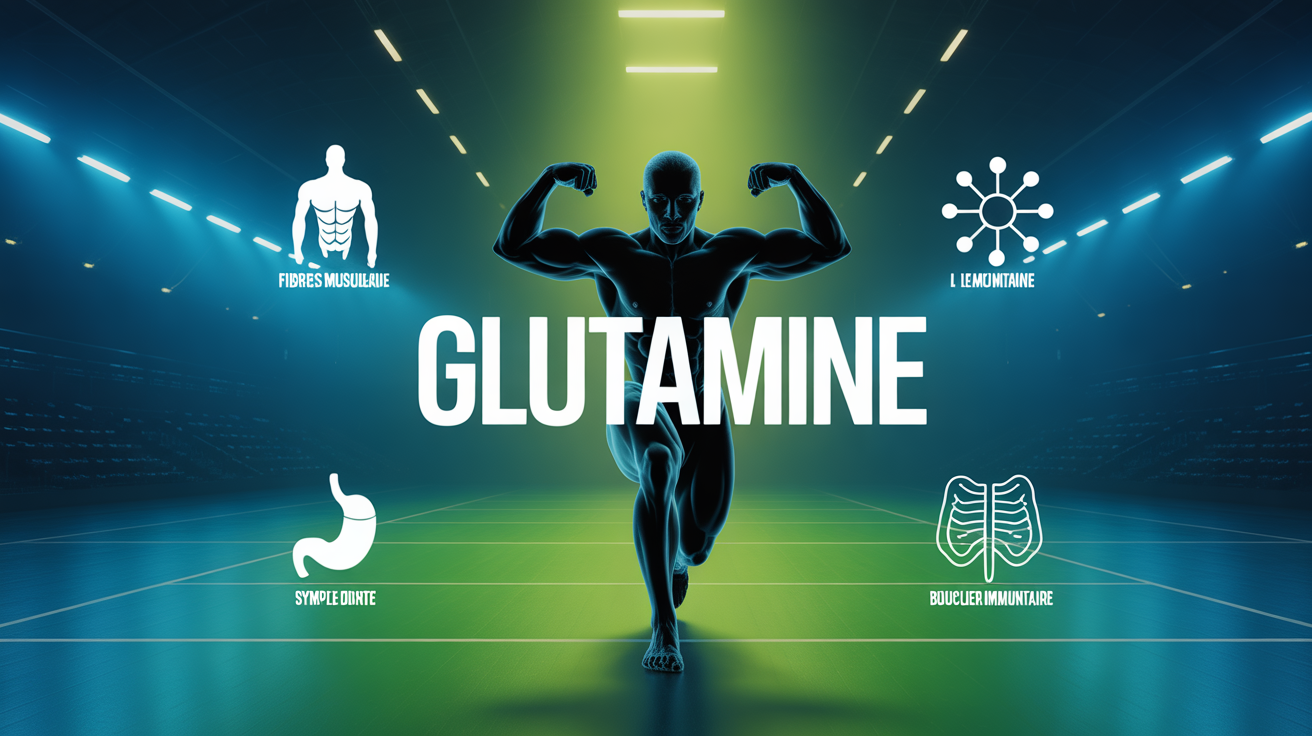
If glutamine is taking an increasingly important place in the routine of bodybuilding enthusiasts, it is precisely because it questions both our benchmarks on muscle recovery and our search for a sustainable balance between performance and health. Over the course of studies, we notice that the scientific literature invites us to nuance the promises displayed: each organism reacts according to its training, diet, or stress level. Ultimately, it is worth being informed with perspective to make choices suited to your own rhythm (in fact, a nutrition trainer recently mentioned the case of students for whom a simple protocol adjustment changes everything).
Glutamine in Bodybuilding: Effective for Recovery – Real but Nuanced Support
Glutamine raises many questions among athletes: accelerated recovery, reduced fatigue, better muscle progression… but should you expect spectacular results? The key point is that glutamine primarily acts as a “safety net” to preserve muscles after exertion and support your immunity, especially during phases of significant physical stress. However, its benefits remain measured: to give you an idea, according to the latest studies (Lu, 2024; Street, 2011), supplementation of 5 to 10 g after training helps replenish muscle stores, reduce the feeling of fatigue (up to -20% on certain criteria) and protect digestive health – but nothing replaces solid meals or truly restful nights.
Should you then bet on glutamine, or reserve it for certain profiles? Honestly examining these questions regularly allows for more serene training, without falling into unnecessary overconsumption.
What is Glutamine?
Glutamine is the most abundant free amino acid in the body: nearly 60% of reserves are found in skeletal muscles. It is frequently presented as a “buffer amino acid” thanks to its easy circulation between tissues, which allows it to support energy recovery and cellular repair. In practice, glutamine plays three major roles: it participates in protein synthesis (muscle building), fuels energy creation (ATP) during sustained efforts, and functions as an immunity regulator.
An intriguing point: after a particularly intense session or under prolonged stress, a temporary drop in blood glutamine levels can occur. What happens then? The body draws more from your muscle reserves, which slows progress. This is why, in certain contexts, it is recommended to “recharge the batteries” (by the way, some practitioners report that after a competition, exhaustion is felt much more strongly…).
Key Physiological Roles of Glutamine
Here is what the scientific literature highlights as major biological actions of glutamine:
- It intervenes in the repair of muscle fibers after training, a process appreciated by many coaches.
- Promotes the synthesis of glycogen (muscle energy reserve), useful during sequences of efforts or to avoid the famous “empty tank.”
- Plays a buffer role for ammonia, a toxin produced during exertion, thus contributing to healthy recovery.
- Participates in strengthening the intestinal barrier (reducing permeability) and supports the immune system, quite often weakened in intensive athletes.
Everyone notices it in one way or another: just one sore muscle after a session is enough to realize that regeneration does not always follow… A nutritionist recently reminded us that glutamine acts silently, but notably in the most exposed profiles.
The Benefits of Glutamine in Bodybuilding
In the gym or at home, many hope to limit physical damage… while preserving their performance and health. It is no coincidence that glutamine often comes up in strategies for accelerated recovery, immune regulation, and limiting muscle catabolism (loss).
Effects on Recovery, Fatigue, and Muscle Health
Recent trials (Street, 2011; Lu, 2024) indicate that glutamine supplementation (5 to 10 g right after training or before bedtime) can:
- Accelerate recovery, with reduced muscle fatigue (Hooper index −20% noted among the most active).
- Help maintain muscle mass when training periods are very demanding or during strict diets/prolonged cutting phases.
- Strengthen resistance to overtraining and limit the “slump” during intense weeks.
One can assume that the usefulness of this supplement is more visible in certain profiles. For example, one practitioner told me they returned to the weight bench without feeling the usual unpleasant soreness from the second week of regular use. Is this really universal? Everyone discovers it through use…
Glutamine and Athlete Immunity
Among the often underestimated points, glutamine stands out for its ability to preserve immune system cells: lymphocytes, macrophages, etc. When the body heavily uses its reserves, we observe that the immune system becomes more fragile, and according to some studies, the risk of an infection arising increases by about 40% after a phase of sustained training. An intake of 10 g after the session would, according to Greenwhey (2024), help limit this vulnerability.
This effect is not easily measured on a daily basis. But if you often get sick or feel unusual fatigue, glutamine might be worth incorporating. Some professionals believe that this point is often overlooked in recovery assessments.
Natural Glutamine or Supplement? What Intake to Prioritize Based on Your Profile
Before buying the first jar online, it is better to take the time to assess your needs: everyday diet covers most intakes except in the case of overtraining or an unbalanced diet. Meats, poultry, fish, eggs, dairy products and – to a lesser extent – legumes, spinach, provide significant amounts on the menu (we often notice that omnivorous athletes reach their needs without supplements).
Food Sources vs Supplements: The Match
Analyses from the USDA database and practitioner feedback confirm:
| Food Source | Glutamine (g/100g) |
|---|---|
| Cooked Beef | 1.2 – 1.5 |
| Whole Egg | 0.6 – 1.0 |
| Fresh Cheese | 0.7 – 1.2 |
| Cooked Spinach | 0.3 – 0.5 |
| Whey/Purified Glutamine Powder | Minimum 5.0 – 10 (depending on dosage) |
An athlete following a balanced diet receives on average between 5 and 8 g of glutamine from their plate. Supplementation can become interesting if your training pace intensifies, if you severely limit animal proteins (as is the case for vegetarians/vegans), or if you want to better distribute your intake around sessions.
Everyone adapts their strategy: an employee who trains at the end of the day will find it simple to add 5 g of glutamine to their post-workout shake, while a carnivorous chef can do without it without regret. Moreover, a sports dietitian recently pointed out that the majority of typical profiles do not need systematic supplementation…
When to Take Glutamine? Timing and Typical Protocols
Here are some useful benchmarks, drawn from expert guides:
- Generally, 5 to 10 g immediately after exertion, diluted in 250 ml of water or a drink containing carbohydrates.
- For repeated efforts, competitions, or injury: up to between 10 and 30 g divided throughout the day (rarely necessary outside of intensive cases).
- In preparation for sleep: 5 g just before bedtime to maximize nighttime recovery.
Many practitioners report effects on recovery from the first week; however, the impact on muscle mass can be discerned after 2 to 3 weeks. A coach mentioned that this timing varies according to the practitioner’s age and athletic background, proof that each case requires adaptation.
Dosage and Safety: What Studies and Practices Recommend
The dosage question deserves attention – and caution too. Clinical trials indicate good tolerance up to 30 g daily. But in practice, most athletes are between about 5 and 10 g per dose, post-workout or before bedtime. The only notable risk, at high doses and in the long term: digestive disorders (bloating) or overload, a fairly rare situation but to be monitored if there is kidney fragility.
Practical Tips for Healthy Dosing
Some benchmarks for truly responsible supplementation:
- Favor short cycles (3 to 4 weeks) during high-volume training phases; some experts recommend taking regular breaks.
- Do not hesitate to seek the advice of a health professional if you have a chronic illness, are taking treatment, or have any doubt (a nutritionist reminded us that consulting beforehand avoids many inconveniences).
- Remember to check the product certification: “Made in France,” vegan/vegetarian label, WADA… For practicality: $17.99 per jar, about $71.96/kg for the most popular ones, shipped in 24-48h with delivery included from $49.
It is not the magic powder that will make all the difference, but a wise balance between individual demands and collective caution. A trainer recently warned: “It seems harmless, but marathon-style self-supplementation is not always obvious in the long run.”
To optimize your recovery, it’s essential to make informed choices tailored to your unique needs, much like selecting the right foil discipline for your preferences with windfoil or wingfoil.
While glutamine plays a crucial role in recovery, exploring complementary methods like Cryotherapy Bodybuilding: Boost Your Recovery and Performance Differently can further enhance muscle repair and overall performance.
Incorporating glutamine into your routine can complement strategies like a cutting breakfast to maximize fat loss and morning energy, supporting both recovery and overall performance goals.
FAQ and Myths About Glutamine: Benchmarks to Navigate
We encounter a “gray zone” when marketing promises mountains and wonders. Another point to keep in mind: taking the time to decode each argument helps avoid traps.
Does Glutamine Really Build Muscle?
No, not directly. It supports muscle synthesis and recovery, but only training rigor, combined with a well-constructed diet, makes the real difference. No supplement can replace daily discipline, even if glutamine remains a discreet little boost. It sometimes happens that a practitioner under supplementation reports progress on feelings, more than on actual mass.
What Dosage to Choose and When to Take It?
5 to 10 g is recommended immediately after the session, alone or combined with carbohydrates/BCAAs to enhance recovery. A second intake (5 g) can be considered before bedtime during your biggest weeks. Stay well below 30 g/day, unless specifically advised by a doctor (a coach reminded us that regular follow-up avoids overdosing).
What Risks or Contraindications Should You Know?
At “sport” doses (5-10 g), glutamine is considered safe, except in cases of renal insufficiency or identified allergy. ANSES recommends seeking medical advice before starting any supplementation, especially if a chronic condition is suspected. Better safe than sorry; some experts see too many athletes neglect this point – and regret it later.
Glutamine or BCAAs: What to Choose?
If we compare: glutamine targets overall recovery as well as digestive and immune health, where BCAAs act more during exertion (energy, immediate anti-catabolism). With a limited budget, it is better to choose the supplement suited to your recovery rhythm, then, if needed, consider combining both. Moreover, a physical trainer shared that for his athletes, the priority always goes to recovery before fine-tuning optimization.
Where to Find Natural Glutamine?
It is easily found in meat, fish, eggs, dairy products (yogurt, cottage cheese), some legumes, and some green vegetables (spinach, parsley). A varied diet is generally sufficient for a “recreational” athlete. Supplementation is aimed at cases of extreme efforts, very strict diets, or particular recovery needs. We regularly notice that the majority of amateur athletes largely cover their intake without external help.
Comparison Table – Natural Diet vs. Supplementation
To visualize the differences, your choice will be made by crossing cost and effectiveness:
| Option | Glutamine intake/day | Indicative cost | Notes |
|---|---|---|---|
| Balanced diet | 5–8 g | Included in varied meals | Covers up to about 80% of needs outside competition period |
| Classic supplement (500g powder) | 5–10 g | $17.99–30 / jar | Perfect in intensive phase; 1 jar for 1 to 2 months |
| “Pack” formulas (glutamine + BCAA) | Variable | $35–65 | Designed for advanced recovery, to be validated by medical advice |
Ultimately, your choice will depend as much on your goals (progress, recover, aim for competition) as on your daily life: time, budget, and specific needs. An expert consultant recently reminded us: “Nothing beats a realistic adaptation to your own situation.”
Testimonials, Certifications, and Safety Tips
Safety remains at the heart of reviews: check for the presence of “Made in France” mentions, “vegan/vegetarian” label, “WADA,” or sourcing transparency. Some successful products display customer ratings of 4.55/5 after more than 200 reviews, which shows their popularity; but personalized advice remains preferable before changing your habits. In practice, some coaches recommend reading product sheets carefully, asking questions if in doubt, and, if necessary, going through the FAQ to better target your profile.
Last point to note: if any question persists, do not hesitate to contact a coach, a health professional, or consult specialized resources on recognized sites; an anecdote often comes up in the gym – a too-quick choice sometimes results in side effects that could have been avoided…